
Fight Environmental Extinction Complacency - Study the "Great Dying" at the Permian/Triassic Boundary

The Permian period ended about 250 million years ago with the largest recorded mass extinction in Earth’s history, when a series of massive volcanic eruptions is believed to have triggered global climate change that ultimately wiped out 96 percent of marine species in an event known as the “Great Dying.”
According to Justin Penn, a doctoral student at the University of Washington (UW), the Permian extinction can help us understand the impacts of climate change in our own current era. -- Mike Gaworecki , Mangabay, 2019
Looming Climate/Environmental extinction never quite rises to the immediacy of mass panic due, perhaps, to the way in which we digest the environmental story - in vague fragments, with no crescendo, no context and no imagined conclusion. In the US we are a nation of climate illiterates. We absolutely must be aware of the undeniable fact that our climate narratives have been significantly curated by filthy amounts of oil industry cash. The Heritage Foundation and the Heartland Institute - like all outposts of the Koch Network - have money to burn when it comes to public manipulation. Consequently, when the climate edges into our thoughts it has plenty of room to move, to squirm, to reinvent itself over and over again, and it slinks away on cool nights. Our innate propensity for denial compels us to reach for the false promise offered by natural moments of respite. Right now, as I write, the temperature lingers at about 65 degrees Fahrenheit on July 8th at 7AM. Trees frame my backyard, lush verdant and immortal - the reminder of natural resilience. I have almost forgotten the week of record breaking heat that tip-toed away three days ago.
When the weather heats to levels of unprecedented discomfort, right wing trolls crowd into online comment sections to write, “It’s summer!” with an air of triumph. Bear with me, there are ways for laymen like ourselves to contextualize our climate nightmare - to make it vivid, visceral and immediate. Climate literacy is absolutely critical to our political selves. When I claim that we fail to see climate as a reason for mass panic, I do not make any assertions about the validity of anyone’s personal emotional response regarding climate. I am simply saying that we are in a climate predicament that objectively represents a degree of stunning urgency that remains just beyond our conceptual grasp. The climate threat may be quantifiable, and concrete, but ultimately, we will live or die via the mechanisms of mass psychology and political organization. “We the people” will either react in adequate numbers to the threat of extinction or not.
The balance between hope and despair may concern some climate activists, but it is a non-issue for me. I follow the seam of fossil fuel industry propaganda that invariably seeks buoyant optimism about climate. If anything, we have been starved of life-giving despair. Despair is the precondition for resistance.
Climate ambiguity is always about “when,” never about “if” – natural/tectonic forces across geological time have destroyed life in episodic acts of extinction. CO2 is nature’s preferred weapon – given enough time and a limitless quantity of greenhouse gasses, heat has built to lethal and epic levels. All rational people understand that current levels of greenhouse buildup will (at some vaguely specified point in time) wipe us off the face of the earth if we don’t achieve the iconic net-zero. But can greenhouse gasses deliver natural/historical catastrophes in human time scales? Climate change has always, until quite recently, been tethered to geological time. We therefore have no historical analogies - climate change has no Hiroshima, no Nagasaki – its cautionary tales can only be studied in “deep time.” We, however, futilely measure the trajectory of climate with the feeble ruler of our own lifespans. Most scientific climate modeling fails to project beyond the year 2100 - 74 years into the future, barely less than an average human life span.
“When you talk to policymakers and stakeholders about sea-level rise, they mostly focus on what will happen up to 2100. There are very few studies beyond that,” says Hélène Seroussi, the study’s first author and an associate professor in Dartmouth’s Thayer School of Engineering.”
This 2024 study being referenced above warns of the overwhelming likelihood that Antarctica’s ice shelves will completely collapse, thus creating a five and a half foot rise in sea levels by the year 2200. In a culture that strains its moral scrutiny to envision a future more than a single lifespan over the horizon, how impossibly remote is the year 2200? As I walk about my home town of Northampton, Massachusetts, many of the stately houses were built at roughly that point in time aimed backwards - 174 years ago Emily Dickinson would have turned 22 in 1852. Emily Dickinson exists as a current and relatable feature of our local culture. We gaze into the recent past with immediate access to our history, but fail to form even the most tentative intimacy with the near future.
The climate will get us - (ourselves perhaps) our children, our grandchildren, our great grandchildren, and our great, great grandchildren have increasingly diminishing likelihoods of a decent quality of life at best, and of mere survival at worst. The question cannot rationally be posed about if, only about when the climate comes for our descendants. By the year 2300, scientists cannot rule out a fifty foot rise in sea level. That would put us on the trajectory to fill the low lying US mid-west corn-belt with Mesozoic Era style inland seas. But the Mesozoic departed 66 million years ago and we are talking about the US hinterland in less than 300 years. Geological time confuses us.
Climate journalism has failed to conceptualize the urgency of our predicament. We are descending into Permian levels of biological misery at warp speed. The earth is heating up (in mere) centuries to levels of distress that, in the most catastrophic event in the earth’s 540 million year history of complex life, may have taken tens of thousands of years to transpire.
Climate overheating is a story - heretofore rooted in “deep time” - that requires basic geological historical literacy to nominally comprehend. The Permian “Great Dying” occurred 251.9 million years ago at the Permian/Triassic boundary. The Permian/Triassic extinction event provides the most analogous template to understand the present risks and probabilities of catastrophic climate heating. The mother of all mass extinctions provides us with missing context - the inevitable result of runaway CO2/greenhouse gas buildup will once again be the demise of species. What is missing from both the past Permian event, that resulted in the mass extinction of most living things, and the currently transpiring capitalist perpetrated, profit motivated extinction event, is the timeline. Scientists do not know how quickly the Permian extinction built up to lethal conditions, and obviously, we have little consensus regarding our current, suicidal act of bio-destruction. Are we doomed in a half century, or will it take many hundreds of years? Does the end Permian offer us a means to give our current extinction event familiar context? The parallels create a potential road map that requires an ability to see geological details as thematic, repeating events.
Human catastrophes cannot be siloed, for our predicament, however uniquely self-inflicted, follows the same laws of physics that determined the results of volcanism and other natural perpetrators of greenhouse buildup. The Permian “Great Dying” is believed to have resulted from two interacting events, the protracted outgassing from the Siberian Traps Large Igneous Province (whose remnants exist in present day Siberia) coupled with the volcanic ignition of adjacent coal fields. Coal fields sequester tens of millions of years of accumulating carbon, and the burning of massive quantities of stored carbon instantaneously (in both ancient and current examples), unites the end Permian with our present moment.
The Permian extinction has often been described as coming close to sterilizing the planet via an explosive rise in greenhouse gasses, and concomitant temperature rise. Oceans achieved the temperatures of hot tubs, anoxic and acidified waters destroyed coral reefs, and inland Pangea became a vast desert. Descriptions are speculative, but the study of end-Permian strata leaves little ambiguity. This from the geology text - Out of Thin Air: Dinosaurs, Birds, and Earth’s Ancient Atmosphere (2006) gives readers an image of our probable destiny if capitalism’s environmental program limitlessly rides on current momentum:
“A voyage 251 million years ago would put us at the very end of the Permian Period. Even at the poles there is no ice. The world is hot and desert-like. There is little plant life, so little, in fact, that soil erosion has caused great dune fields of sand to form. The river systems look like those we saw in our Cambrian voyage where there were no meandering rivers, only ephemeral braided streams—the kind of sheetwash and streamflow that today is found at the bottom of glaciers of alluvial fans—places without vegetation, for it is the roots of plants that allow rivers to have bank stability, which is required for meandering rivers. This place is akin to the time before land plants. Harsh, hot winds, filled with grit, only make the atmosphere seem hotter. And hot it is—a place of high carbon dioxide and low oxygen. And it reeks of rotten eggs. Great bubbles of hydrogen sulfide are periodically emerging from the sea and larger lakes, for we will find that both of these are filled with bacteria producing this deadly gas.”
Scientists have recently developed a more detailed, focused image of the end Permian – its time lines, its isotopic features of temperature and atmospheric composition. Previously we had imagined the Permian Extinction as an event wholly embedded in geological time scales. The Siberian Traps erupted in a series of pulses over the course of some two million years. The first eruptions preceded the extinction event by 300,000 years leading to the theory that atmospheric and oceanic conditions degraded gradually over an enormous time span. However, a recent paper out of MIT suggests that the fossil record fails to reinforce the theory of a protracted, incremental slide toward mass extinction. Species did not die out in an evenly dispersed sequence of volcanic events across hundreds of thousands of years – they exited the fossil record in a geological eye-blink, a sudden, monstrous event that gathered up even the most resilient and long lived members of the biosphere in a virtual moment of geological fury. Fish, Trilobites, Rugose Corals, Synapsida – all tumbled into a crevice in time:
“The end-Permian mass extinction, which took place 251.9 million years ago, killed off more than 96 percent of the planet’s marine species and 70 percent of its terrestrial life — a global annihilation that marked the end of the Permian Period.”
The MIT research summary quoted above goes on to emphasize the primary finding of the study:
“The new study, published today in the GSA Bulletin, reports that in the approximately 30,000 years leading up to the end-Permian extinction, there is no geologic evidence of species starting to die out. The researchers also found no signs of any big swings in ocean temperature or dramatic fluxes of carbon dioxide in the atmosphere. When ocean and land species did die out, they did so en masse, over a period that was geologically instantaneous.”
It is well known that volcanic outgassing raised CO2 concentrations over eons of time leading up to the mass extinction, but the extinction itself did not take place in parallel fashion (according to the above linked paper) to the buildup – it struck “instantaneously.” In geological time frames instantaneous means, “give or take 31,000 years.” Stanford Geologist Jonathan Payne, after reading the MIT study, concluded, “It is even possible that the main pulse of Permian extinction occurred in just a few centuries.”
This speculative possibility points ominously toward our own era – a time of extinction level pulses that transpire at a velocity exponentially greater than at any time in geological history (including the Permian/Triassic event). In the past year, the CO2 atmospheric concentrations have jumped by 5 PPM while following a curved trajectory that has unfailingly seen escalating rates of CO2 concentration.
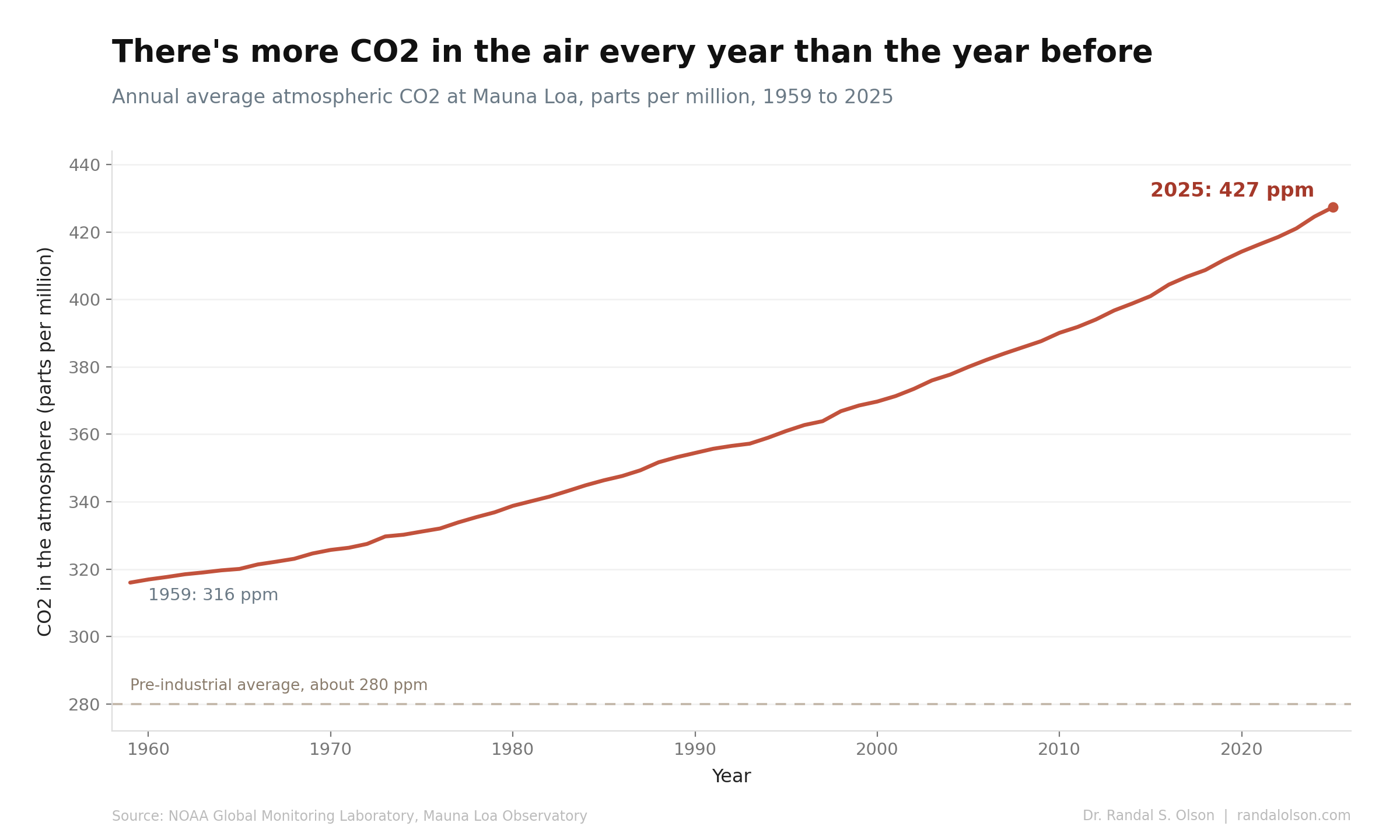
If the rate of C02 PPM grew statically at 5 PPM per year (it is, however, not static, but increasing, as the above chart proves) we would add 1,000 PPM in a mere two hundred years – replete with feedback loops, massive release of frozen methane stores, political turmoil and likely collapse of ocean currents and terrestrial food chains.
If the MIT study refines our understanding of the nuances of geological time scales regarding mass extinctions, another geological study out of the University of Leeds offers yet another warning. This study, focusing on ocean temperatures across the entire Phanerozoic, concluded that slow natural processes, particularly rock weathering that sequesters carbon in limestones, likely regulates earths temperatures and act as brakes in the form of a negative feedback loop. As temperatures increase, so does rock weathering and concomitant carbon sequestering. However, current CO2 and temperature buildups – transpiring at far faster velocities than those of the past, may not allow for natural regulating processes to catch up. The Leeds study warns:
“We shouldn’t be complacent when viewing ancient hot climates that supported diverse ecosystems, and we must understand that they were established extremely slowly, and may not have been as hot as recently proposed. Earth’s natural regulation systems are slow, and humans must perform our own climate regulation to keep the planet in a habitable range.”
The speed of human caused climate change is the key that makes natural systems of remediation and compensation inadequate. In addition, we cannot view our current environmental crises as a mere matter of greenhouse gasses. We have a host of toxic substances – PFAs, mercury, lead, micro-plastics and other neuro toxins that offer parallel methods of lethal assault, or that operate in tandem with overheating. The rise of fascism coincides with environmental destruction in ways that are complex and reinforcing. Extreme heat causes diminished cognitive/emotional functioning. Capitalist inflicted environmental destruction unquestionably impacts the human capacity to function politically - and this phenomenon remains almost completely unexplored by researchers.
Heat waves may alert us to our gathering apocalypse, but scientific study already tethers us to the Permian event. We are at the end game, with moth numbers already plummeting by 50%. The Permian was uniquely inhospitable to insects – a class comprised of thousands of species, each with such spectacular breeding velocity that only the most oppressive environmental circumstances can threaten their survival. Commercial bee colonies have collapsed catastrophically in the US – by 70% according to estimates. 32% of amphibian species are in danger of imminent extinction. North American bird populations have dropped by 29% since 1970. Freshwater fish populations have been reduced by 81% since 1970. The trajectory of our unravelling biosphere is hardly a secret, and yet we witness no mass mobilization, no frantic resistance commensurate with the statistical evidence regarding greenhouse buildup, increasing heat, escalating weather extremes and dying species.
Mass complacency is one of two essential drivers of our Permian/Triassic reprise. Capitalism and fossil fuel/technology/war industry behavior embodies the mechanism that poisons and overheats our neo-Permian event, but mass capitulation allows the forces of death cult capitalism to mimic the Siberian Traps Large Igneous Province of deep time. Only mass awareness of geological history can save our planet from the cult of oil and technology - climate journalists have a great task ahead. The Permian Gorgonopsids had no means to understand or confront the volcanic events that wiped them off of the face of the earth. Here the analogy breaks down. We can understand the process of environmental threat on a mass level, and choose to abandon the subservience that feeds capitalism. But first we must look long and hard at The Permian/Triassic boundary. Otherwise, our disconnection from earth’s natural history will assure our doom.
excellent essay.
I sometimes wonder why people don't get climate change. It became obvious to me in 1970 when I was on a scuba diving trip to Grand Cayman (my first and last). On the trip was a wildlife biologist, who, one evening on the beach, said we were in the last golden age of planet earth. He proceeded to explain. Here we are.